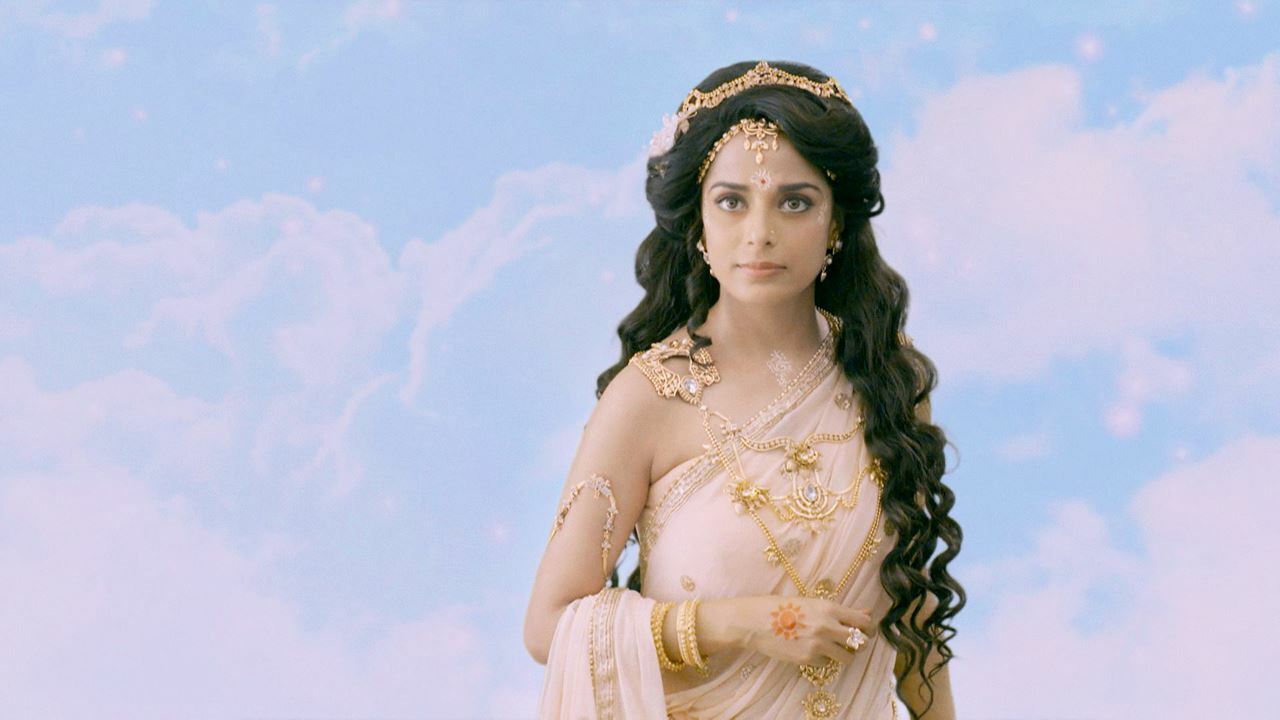
There was once a king. His name was Prajapati Daksha. He is said to have been nothing less than the son of the god Brahma himself. Brahma recommended Daksha to worship the Great Goddess so that She could take incarnation as Daksha’s daughter. Brahma had a plan: he wanted Shiva to marry Sati, when she got matured and thus attract him to participate in the affairs of the human world.
The Great Goddess incarnated in the youngest daughter of Prajapati Daksha and she was named Sati, which means Truth.
Sati had revered Shiva since childhood and did not want anyone else as her husband except Shiva. Her father, however, despised Shiva, refused to honor him as a god and did not want to hear about his beloved daughter becoming the wife of a forest tramp who smoked something and meditated among the corpses.
When it was time for Sati to get married, the king arranged a swayamvara. It was a special custom for a girl to choose a groom. Princes from all over the world were invited to the palace, one more beautiful than the other. But, as we understand, Sati's heart had already been given to Shiva, and when she threw the wedding garland, it fell just on Shiva, who suddenly appeared at the place where the garland fell in full accordance with the girl's wishes.
Daksha was furious, but he did not dare break the law and released the newlyweds on all four sides, after condemning Sati for her choice and forbidding her to return to his kingdom. Sati and Shiva lived many wonderful years after their wedding on Kailas, high in the Himalayas. One day a saint named Narada arrived on Kailas with the news that Daksha was planning a big festival and sacrifice, a festival to which all the gods and their families were invited. Naturally, neither Sati nor, moreover, Shiva were invited by the king to the celebration. Shiva, anticipating the negative outcome of this celebration, did not want to let Sati go, who was eager to go there and to reconcile with her father. In the end, Shiva yielded to Sati's insistent requests and gave her permission to go to Daksha's palace after she had manifested herself in front of him in Her ten terrifying forms known as Dashamahavidya.
So, the bull Nandi, a devotee of Shiva and Sati, delivered the Goddess to Daksha’s palace. When Sati tried to hug her father, rejoicing at her meeting with him, he rudely pushed her away and began to revile Shiva, calling him a beggar tramp. Sati was deeply hurt. As a devoted wife to Her husband She could not listen to such insults. Feeling her soul stained with dirt from the mouth of Her biological father She said that She refused to live in such dishonor anymore, and using Her inner strength She burned herself in the fire, falling dead at the feet of her heartless father.
When Nandi returned to Kailas and told Shiva this sad story, Shiva's anger got out of control. In his rage, he created Virabhadra, a warrior capable of fighting even with the gods and defeating them. Shiva shook his matted locks, and a whole army of snakes, giant monsters and ghosts came out. They did not leave a stone unturned in Daksha’s palace. Virabhadra, on the other hand, cut off Daksha's head and put to flight those gods who were bound by their oath to protect Daksha, including the god Vishnu.
Shiva also arrived at the palace. He was not interested in anything except Sati's body. Taking it in his arms, he began his dance of destruction. The earth was shaken by terrifying earthquakes, giant tsunamis rose from the ocean, volcanoes woke up, and forests were filled with fires. All living things were put on the verge of destruction.
To save the human race from destruction, Vishnu, one of the three greatest gods, threw his Sudarshana Chakra into Sati's body and cut it into 51 parts. In those places where parts of the Goddess's body fell to the ground, there are now temples dedicated to the Mother Goddess. These places are called shakti-pithas and are considered to be the most sacred.
Shiva, feeling that Sati's body was no longer in his hands, retired to Kailas and plunged into the longest meditation of his life.
What can this story about Sati teach us, the people of the 21st century? A lot. For me personally, several important lessons are opening up here.
Lesson One. If the father is a fool, then do not try to reason with him, appealing to some lofty feelings and trying to reconcile with him, and so on. This applies not only to the father-daughter relationship, but also to any relationship between people. If you are not accepted and pushed away, then you do not need to look for more meetings with such people, even if these people are your parents. Don’t forget that parents are not everything. Sati's story confirms this. Daksha was just her biological father, he did not even carry Her for nine months in his body, but only performed an act of ejaculation into the womb of Sati’s biological mother. The supreme father is the Supreme, and the supreme mother is the Mother Goddess. You should seek Their advice and guidance if your earthly parents are fools. In present days, alas, parents are often hopeless fools. But this is not a problem if you understand that there are the Heavenly Father and Mother who you can worship and whose protection and guidance you can get.
Lesson Two. Although Daksha was the son of Brahma, he himself was an arrogant and ignorant person, unable due to his arrogance and ignorance to see God in Shiva, and the Mother Goddess in Sati. Hence being born into a high-born family, even in the family of God, does not make a person worthy of respect, nor of the privileges that are inherited by birthright. Only personal merits and personal work, self-sacrifice and the sufferings and obstacles that a person overcomes on the Way - only they turn a person into something higher. Neither being born in a high caste, nor money, nor position by themselves can make a person either smarter or wiser. Only personal qualities developed by the person himself are able to make him a Man with a capital letter, or even turn him into a living God. There are some examples of such people in the history of mankind.
Lesson Three. Evil is relative. Daksha gave birth to a terrifying series of events by his arrogance, but on the other hand, if there had not been this series of events, would 51 Shakti pithas have been created? Would these sacred places of worship of the Great Mother have arisen? We can learn a very important lesson from this. Certainly, we are not immune from evil from other people. However, it is in our power to turn this evil into good. This is how this universe is built. The beginning of the new is already hidden in the destruction of the old, the acquisition is hidden in the loss, and the solution already exists in the problem.
Lesson Four. Sati didn't have to burn herself just because the idiot father had said some undeserved nasty things about Her husband. In this regard, I recall the words of Christ, who once said: "It is not that which enters into a person that defiles, but that which comes out of him that defiles." Therefore, no matter what dirt a person lives in, he can remain internally clean. And on the contrary: a person can live in a clean room, walk in clean clothes and always have a perfectly washed body, but can be dirty and smelly, because his thoughts, words and actions are dirty and disgusting. Therefore, everything said by Daksha discredited only him and no one else. Sati, being a goddess, however, was also a person at the same time. Let's not forget that She lived in that world and in that era where critical analysis was not as developed as it is now, so, of course, we cannot blame Her for misunderstanding the situation. It was a Vedic world, and the words of the father - albeit a near-minded one - were taken very seriously.
Lesson Five. People like Daksha should not be allowed to power. If they succeed in breaking through there, the result of it is sad. Daksha has been obsessed with his own greatness for the whole life. For which he finally paid. Such creatures are always concerned only with their fantasies, instead of spending God-given time caring for the people's welfare, strengthening the state, educating the people and creating a society of social justice. Their goals are their own enrichment and imaginary greatness. Alas, Kali-yuga knows too many creatures of this sort. These are people with a demonic system of psyche, obsessed with manias. Until mechanisms are put in place to prevent such beings from holding important government posts, the world will continue to be plunged into poverty, exploitation, injustice and ignorance.
For me, the story of Sati is primarily a love story. The love story of a girl from the royal family and a hermit. What is this Sixth Lesson about? It teaches us that love is truly unconditional - if it does not seek its own - and is the greatest force in the universe. Love knows neither class, nor national, nor religious, nor any other restrictions and is able to destroy any obstacles in its path. Therefore, by loving, a person becomes God, overcomes existing limitations and is freed from the fetters of karma. And this is the greatest message to modern man by the Mother Goddess.